
How to Start and Scale a Gutter Business?

To start a gutter business, get a registered LLC, general liability insurance, a work vehicle, basic tools, the required local licenses, and a Google Business Profile. Do market research, choose sub-services, prepare pricing plans, build a customized website and apply marketing strategies like local SEO and ads to be successful.
A gutter business earns revenue through three main service lines including cleaning, installation, and repair. Gutter cleaning costs the least to start and brings repeat customers who book services 2-4 times per year. Seamless gutter installation carries higher revenue per job but demands more equipment. Gutter guard installation, fascia repair, and downspout work are high-margin add-ons that increase revenue per visit.
A gutter business is one of the most affordable trades to enter in the home services industry. Startup costs range from $3,000 for a cleaning-only operation to around $40,000 for a full installation setup. Gutter companies operate at 20-40% net profit margins when run correctly. That outperforms most construction and home improvement trades, where net margins sit between 10% and 15%.
Scaling a gutter business yields maximum profit. To scale a gutter business, add higher-margin services, tighten your pricing model, invest in field service software, lower customer acquisition cost, and apply local SEO strategies. Then expand into new service areas.
Expand into new territory by adding 1-2 zip codes every 30-60 days. Location-specific landing pages, geo-targeted Google and Facebook ads, and partnerships with local roofers and siding contractors bring leads in each new area. Referral programs fill the pipeline faster. Property manager relationships and real estate agent partnerships produce recurring, high-volume work.
Start a successful gutter business by learning from the guide below what you need to do before your first gutter job, how much it costs, where the profit comes from, how to scale past six figures, and how to expand into new territory.
What Do You Need to Start a Gutter Business?
To start a gutter business you need a licensed LLC, $1 million liability insurance, a $5,000-$15,000 work truck, $1,000-$2,500 in gutter tools, the required local licenses, and a Google Business Profile. The checklist below covers each item you want ready before your first gutter job and how to accomplish them.
Market Research and a Business Plan
A business plan maps your target market, services, pricing, and financial projections. Do thorough market research to create a plan for your gutter business. Drive through the neighborhoods you want to serve. Count the competitors on Google Maps. Study their reviews on platforms like HomeAdvisor or Angi. Identify your ideal customer. Are they residential homeowners, commercial property managers, or new construction builders? Choose a service area you can reach within a reasonable drive.
Sub-services and Niche Selection
Decide whether you want to focus on gutter cleaning, gutter installation, or both. Gutter cleaning costs the least to start and brings in repeat revenue. Seamless gutter installation carries higher ticket jobs but demands more equipment. Operators combine cleaning, installation, and gutter guard work to create year-round cash flow. To stand out in a crowded market, choose a focused niche, for example, residential gutter replacement in older neighborhoods.
Business Name and Registration
A strong business name tells customers exactly what you do. Register it with your state’s Secretary of State. File as a Limited Liability Company (LLC) to protect your personal assets from lawsuits. An LLC filing costs between $50 and $500 as a one-time state fee. A sole proprietorship is simpler but offers zero liability protection.
Employer Identification Number (EIN)
Apply for a free employer identification number (EIN) on the IRS website. This number works as your gutter business’s federal tax ID. You need it to open a business bank account and file taxes.
Licenses and Permits
Most cities require a general business license from the local clerk’s office. That costs $50-$100 per year. A dedicated “gutter license” is rare. Many states require a general contractor or home improvement license for jobs over a set dollar amount (often $1,000). Check your state’s contractor licensing board website for thresholds specific to your area.
Insurance
A gutter business carries 2-3 insurance policies from day one. General liability insurance is your first and most critical policy. A standard $1 million policy costs $600-$2,000 per year and covers property damage and injuries on client sites. Commercial auto insurance comes next. You need commercial auto insurance to protect your work vehicle which costs $1,500-$3,000 annually because personal auto policies do not cover business use. Workers’ compensation insurance applies the moment you bring on your first employee. Most states treat this as a legal requirement, not an option.
Work Vehicle
A used work truck or cargo van that transports your ladders, tools, and materials. Install a ladder rack if you plan to do installations. A trailer setup works too, especially if you add a portable gutter machine later.
Equipment and Tools
You need ladders, hand tools and power tools.
- Core items include extension ladders (24ft, 28ft, and 32ft), a ladder stabilizer, gutter scoops, a high-powered leaf blower, buckets, and a safety harness with rope.
- Hand tools like tin snips, hand seamers, crimpers, a downspout punch, and a utility knife round out the basics.
- Power tools include a cordless drill and a miter saw with a metal-cutting blade. Budget $1,000 to $2,500 for this kit.
A portable seamless gutter machine ($7,000 to $17,000) fabricates custom gutters on-site. Most new operators skip this purchase at first and buy pre-formed gutter sections from suppliers instead.
Safety Gear
Invest in a full safety harness, non-slip boots, work gloves, and eye protection. These items are non-negotiable from day one because ladder and roof work is the number-one injury risk in gutter business. According to a 2025 report by Upper Inc., ladder-related accidents cause over 164,000 hospitalizations annually in the United States.
Materials and Suppliers
Aluminum coil, hangers, sealant, downspout components, and fasteners make up your standard material list. Open accounts with national distributors like ABC Supply or Beacon Building Products. Most do not require large minimum orders for standard items. Build relationships with one or two local suppliers and ask about bulk pricing to improve your margins on every gutter job.
Financial Setup
Open a dedicated business bank account to separate personal and business transactions. Track every expense from day one with accounting software like QuickBooks or Wave. Set aside $5,000-$10,000 in working capital to cover fuel, insurance premiums, and marketing costs for your first 60-90 days. The Small Business Administration (SBA) offers microloans up to $50,000 for qualifying startups. Equipment financing is another option where the gear itself serves as collateral.
Pricing Plan
Gutter installation work is priced per linear foot mostly. A standard 5-inch aluminum gutter installation runs between $5 and $10 per foot (labor and materials included). Cleaning jobs work better with flat-rate pricing. Charge around $150 for a single-story home and $250 for a two-story home. Aim for a gross profit margin of 40-60% on each job.
Google Business Profile and Website
Create a Google Business Profile to place your business on Google Maps and local search results. It is your single most powerful free marketing tool. Fill out every field, and upload photos of your truck and completed work.
Build a simple one-page website listing your services, service area, and a clear phone number to add credibility that many of competitors lack.
Go-to-market Plans
Prepare some low-cost local tactics to build awareness and acquire customers fast.
- Print 1,000 door hangers for about $150-$250 and target neighborhoods with older homes.
- Place a yard sign at every completed job site.
- Build referral relationships with local roofers and home inspectors.
- Set up a free Nextdoor and Facebook gutter business page.
- Accept credit card payments from day one. Not offering cards pushes customers toward competitors who do.
A 50% deposit before work begins and the remaining 50% on completion is standard in this trade.
Operations System
Use Google Calendar for scheduling when you start out. As jobs pick up, field service software like Jobber or Housecall Pro helps manage schedules, send invoices, and track customer communication in one place.
It’s ok if you don’t have every item on this list before starting. You can launch with basic gear, a truck, and a handful of local customers and then grow from there. Many profitable gutter businesses started with exactly that. Add the rest as your revenue grows and your customer base expands so that you can bear the cost.
How Much Does It Cost to Start a Gutter Business?
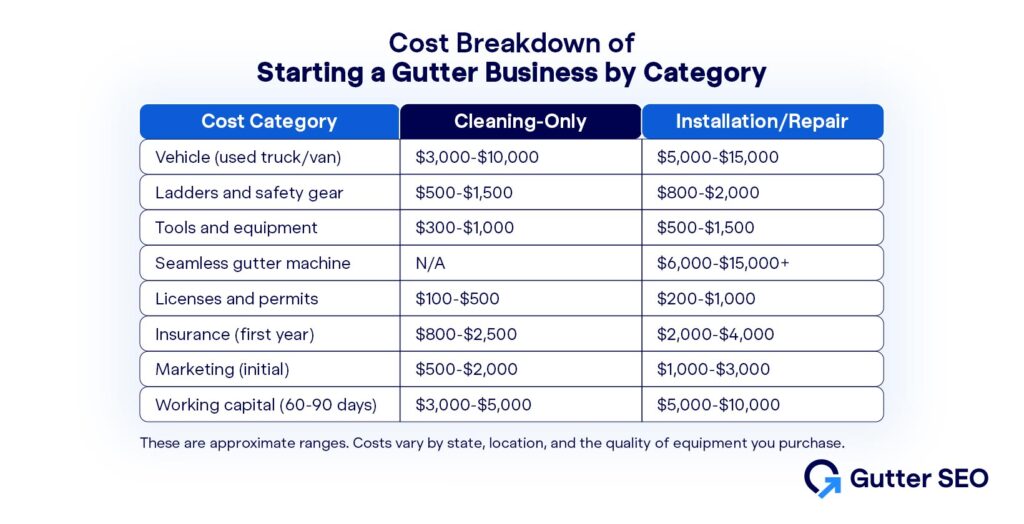
Starting a gutter business costs $3,000-$10,000 for cleaning-only services and $10,000-$40,000 or more for installation or repair. Installation costs increase when you purchase a seamless gutter machine, which ranges from $6,000-$15,000. So, the cost depends on the scope of services you plan to offer. Vehicle, insurance, licensing, tools, marketing, and 60-90 days of working capital determine total startup expenses. Below is a breakdown of gutter business startup costs by category.
- Vehicle (used truck or van): A cleaning-only operation runs $3,000-$10,000. An installation business runs $5,000-$15,000. This cost drops to zero if you already own a truck.
- Ladders and safety gear: Gutter cleaning requires $500-$1,500. Installation requires $800-$2,000. Safety gear includes harnesses, hard hats, and non-slip boots. A worker who falls off a ladder can end your business before it starts, so this is not the place to cut corners.
- Tools and equipment: Cleaning tools cost $300-$1,000. Installation tools cost $500-$1,500. This covers gutter scoops, power washers, drills, rivet guns, and sealant applicators.
- Seamless gutter machine: Expect to pay $6,000-$15,000 for a new portable K-style seamless gutter machine. Commercial-grade box gutter machines exceed $25,000-$65,000.
- Licensing and permits: Cleaning businesses pay $100-$500. Installation businesses pay $200-$1,000. Costs vary by state and local regulations. Some states require a contractor’s license for installation work.
- Insurance (first year): Gutter cleaning insurance runs $800-$2,500 annually. Installation insurance runs $2,000-$4,000 annually. General liability insurance protects you against property damage claims. Workers’ compensation insurance is required in most states once you hire employees.
- Marketing (initial): Cleaning businesses spend $500-$2,000. Installation businesses spend $1,000-$3,000. This covers a professional website, local gutter SEO, local ads, and printed materials like door hangers and flyers.
- Working capital (60 to 90 days): Cleaning operations set aside $3,000-$5,000. Installation operations set aside $5,000-$10,000. Working capital is the cash reserve that covers fuel, insurance premiums, and daily operating expenses before your jobs produce consistent income.
The seamless gutter machine is the single biggest cost decision for your new installation business. You face three options including buying a new machine, buying a used one, or skip it entirely at first. Many new contractors purchase pre-formed gutter sections from a supplier and subcontract seamless work. This approach cuts your initial capital requirement by thousands.
Funding a gutter business is more approachable than most people expect. Self-funding from personal savings is the most common path. The Small Business Administration (SBA) Microloan program offers loans up to $50,000 through nonprofit community-based lenders. A business plan and a credit score above 650 improve your chances. Equipment financing is another popular route. Lenders offer loans tied to specific purchases like a work truck or seamless gutter machine, and interest rates stay competitive because the equipment itself serves as collateral for the loan.
Follow this smart bootstrap path. Start with gutter cleaning, build your customer base, and fund your installation equipment from cleaning revenue. This “clean first, install later” approach keeps your gutter business startup costs low and lets you grow into the business without heavy debt. Plan a six-month budget that covers all operating expenses, including wages, taxes, and benefits if you hire help.
Is a Gutter Business Profitable?
Yes. A gutter business is profitable because it combines low startup costs with high gross margins. Gutter companies operate at 20% to 40% net profit margins at a minimum when run correctly. That outperforms most construction and home improvement trades, where margins sit between 10% and 15%. High demand, low material costs, and recurring maintenance work drive those strong margins.
A gutter business is one of the most profitable trades in the home services industry. The gross profit goal for gutter cleaning sits between 40% and 60%. Standard aluminum gutter installation delivers gross margins of 40-60% on material costs of just $2-$4 per linear foot. According to IBISWorld’s industry report, the U.S. gutter services market reached $778.4 million, with fewer than 5,000 companies competing nationwide. That ratio of demand to supply creates strong pricing power for new operators.
The income potential for a gutter business owner scales quickly with effort and crew size. A solo gutter cleaner running 3-5 jobs per day generates $500-$1,500 in daily revenue. A solo installer charging $8-$15 per linear foot on standard aluminum gutter installation earns strong margins on every job.
Annual revenue for a solo operator ranges from $40,000 to $150,000+, depending on location and job volume. A crew-based operation with multiple trucks produces $200,000-$400,000+ per year. Net profit margins in cleaning reach 30-50%. Installation businesses enjoy net profit of 20-40% after labor costs, material costs, administrative expenses, and equipment upkeep. Below are the key factors that drive gutter business profitability.
- Gutters create recurring maintenance demand. Gutters require cleaning 2-4 times per year in most climates. That repeat cycle creates a built-in base of recurring customers who book your services every season without fresh marketing spend.
- Storm and seasonal damage drives repair work. Urgent storm damage commands premium pricing. Homeowners pay more when water is pouring over clogged or broken gutters, and these jobs carry higher margins than scheduled maintenance.
- High-margin add-ons boost revenue per visit. Gutter guards, downspout extensions, and fascia repair generate extra revenue on every visit. Gutter guard installation averages $1,200 per project and carries profit margins of 50-75%.
- Material costs stay low relative to labor charges. Cleaning jobs require almost zero material investment. Installation material markup sits between 100% and 200% above wholesale cost, making your price per foot highly profitable.
- Repeat customers generate referral potential. One good job on a street can lead to three or four neighbor referrals. A single $150 repair can turn into a $10,000 gutter replacement within 3-12 months and generate an online review that drives even more leads.
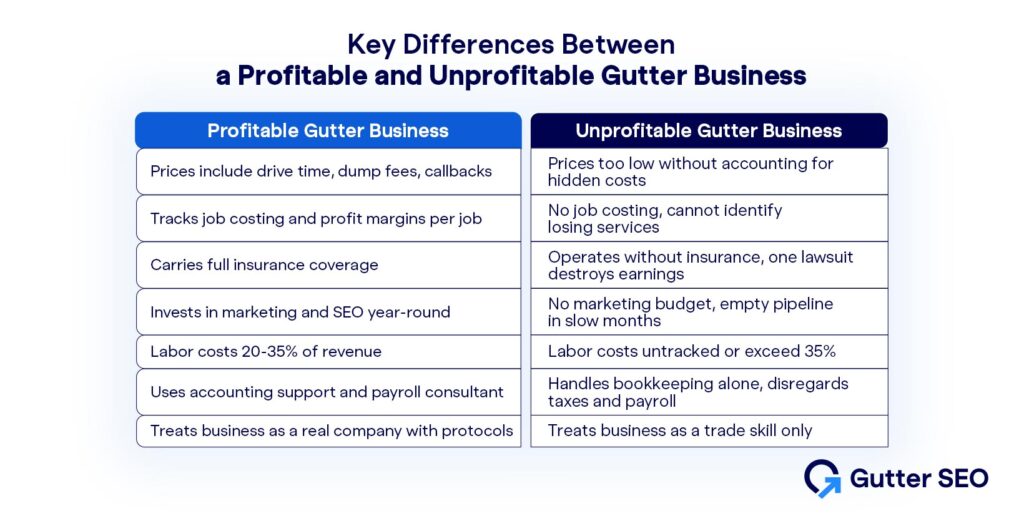
Your pricing model determines your profitability more than any other factor. Installation businesses charge a price per foot. Cleaning businesses use flat-rate pricing. Multi-story homes and heavily clogged systems carry surcharges of $50-$100 per job. Underpricing is the single biggest profitability killer in this trade. Don’t set prices based on what competitors charge without calculating your own true cost per job.
How Do You Scale Your Gutter Business Profitably?
To scale your gutter business profitably, increase average job value, maintain 40-60% gross margins, lower customer acquisition cost, add higher-margin services, and optimize routes to keep drive time under 15%. Here is a 10 step scaling playbook that covers the operational, financial, and marketing moves that you need to make.
- Add higher-margin services first. Gutter guards, repairs, fascia and soffit work, pressure washing, and roof cleaning each increase your average job value. Think of every add-on as an upsell. You’re already on-site, so the extra labor cost stays low and your profit per visit climbs.
- Tighten your pricing model. Don’t guess prices. Use a formula-based approach such as, material cost + labor hours + overhead + target margin. Your goal for gross profit per job is 40-60%. Mark up materials by 50-100% to cover sourcing time. Track job costing data after every project.
- Invest in digital tools. Use field service software like Jobber, Housecall Pro, or ServiceTitan to handle quoting, scheduling, and invoicing from one platform. Multi-option estimates in tools like Jobber let businesses present good, better, and best scenarios. It increases average ticket sizes by up to 30%. Faster quotes close more jobs. Automated follow-ups keep leads from slipping through the cracks.
- Lower your customer acquisition cost. Customer acquisition cost (CAC) is the total you spend on marketing and sales to land one new customer. A realistic starting CAC for gutter businesses sits around $120, with a target to bring it down to $90 over time through referral programs and retention.
- Build authority online with local SEO. Outrank your competition with local SEO and Google Business Profile optimization. Supplement these with Google Local Services Ads. Build a review engine by asking every satisfied customer for a Google review. Optimize your website for AI centric traffic. Get a free gutter SEO growth audit and uncover the highest-impact organic opportunities in your service area.
- Build service density through route optimization. Service density is the number of jobs your crew completes in the same geographic area during a single day. Batch jobs by zip code and map routes geographically, because more jobs per day in the same neighborhood means more revenue per technician hour and lower fuel costs.
- Hire and build crews. Start with 1099 subcontractors, then move to W-2 lead installers, then crew leads, and then a production manager. Each hire must pay for themselves within 30-60 days. Start planning for a second truck when your first crew generates around $250,000 in annual revenue. Expand only when your lead flow is stable and your schedule stays booked 3-4 weeks out.
- Build recurring revenue. Develop annual or biannual service agreements that provide predictable income and strong customer retention. Recurring revenue stabilizes cash flow and reduces your marketing spend per job because you stop re-acquiring the same customer every season.
Scale your gutter business by building repeatable systems like pricing formulas, SOPs, digital tools, crew structures, and marketing channels that let the business grow beyond your personal output. Then expand your service area. The gutter companies that reach seven figures operate this way.
How Do You Expand Your Gutter Business Service Area?
Expand your gutter business by adding 1-2 zip codes every 30-60 days, building location-specific landing pages, applying local SEO strategies, optimizing your Google Business Profile, running geo-targeted ads, forming contractor partnerships, and launching a referral program. Below are 8 proven tactics to expand your gutter business into new territory.
- Create location-specific landing pages. Create a separate page on your website for each new city or zip code. A page targeting “gutter repair near me” in a specific town performs far better than a single generic service page. Include the city name in the title, a local photo, a clear call-to-action, and unique content. This local SEO tactic helps search engines connect homeowners to your gutter services in that exact area.
- Optimize your Google Business Profile. Your GBP is how local customers find you on Google Maps. Update your service area to reflect every new location. Keep your NAP (name, address, phone number) consistent across all directories like Yelp, Angi, and the Better Business Bureau.
- Run geo-targeted ads. Google Ads and Facebook/Instagram ads let you target homeowners in specific neighborhoods and zip codes. Google Local Services Ads operate on a pay-per-lead model, so you pay only when a customer contacts you through the ad. This makes them a cost-efficient channel for entering new markets.
- Build strategic partnerships. Roofing companies, siding contractors, landscapers, and window installers interact with the same homeowners you want to reach. Partner with these contractors in your new target areas. They send you gutter leads. You send them referrals for their services. These warm leads convert faster than cold advertising because trust already exists.
- Connect with property managers and real estate agencies. Property managers handle multi-family buildings and HOA contracts. Real estate agents want gutters cleaned and inspected before listings go live. Offer move-in/move-out gutter packages. These relationships produce recurring, high-volume work that fills your schedule fast in a new territory.
- Launch a referral program. Offer a gift card or discount for every booking that comes from a referral. A referral from a neighbor carries more weight than any ad. According to a Nielsen consumer trust report, approximately 88% of people trust word-of-mouth recommendations over other forms of advertising.
- Use physical marketing. Door hangers, flyers, community board ads, and local newspaper spots still work. Distribute flyers to the 50-100 nearest homes after finishing a gutter installation or cleaning in a new neighborhood.
- Confirm operational readiness before you go. This is non-negotiable. Make sure you have a crew or sub-contractor ready for the new area, your scheduling software can handle wider geography, and you have a quality control process.
Expanding your gutter business too quickly leads to missed appointments, sloppy gutter slope, and bad reviews. Those reviews can follow you for years. Treat service area expansion like a test, not a leap. Add one or two ZIP codes at a time. Track your leads, close rate, and review scores in each new area. Move forward only when the numbers support it.